
Cleaning costs aren’t random, even if it sometimes feels that way when you get different quotes. In most cases, they’re built around a simple mix of time, home size, and the type of work involved.
If you understand how that formula works, you can quickly estimate what a fair price should look like before booking a service or quoting a client.
This guide is for both homeowners who want to avoid overpaying and cleaning business owners who want to price jobs properly without guessing.
You’ll learn how cleaning costs are actually calculated in real life, what goes into a proper quote, and how professionals break everything down step by step, from labor time to final pricing.
Cleaning Cost Formula Used by Professionals (Snippet Target)
Cleaning cost is calculated using a simple structure that most professional cleaning companies follow:
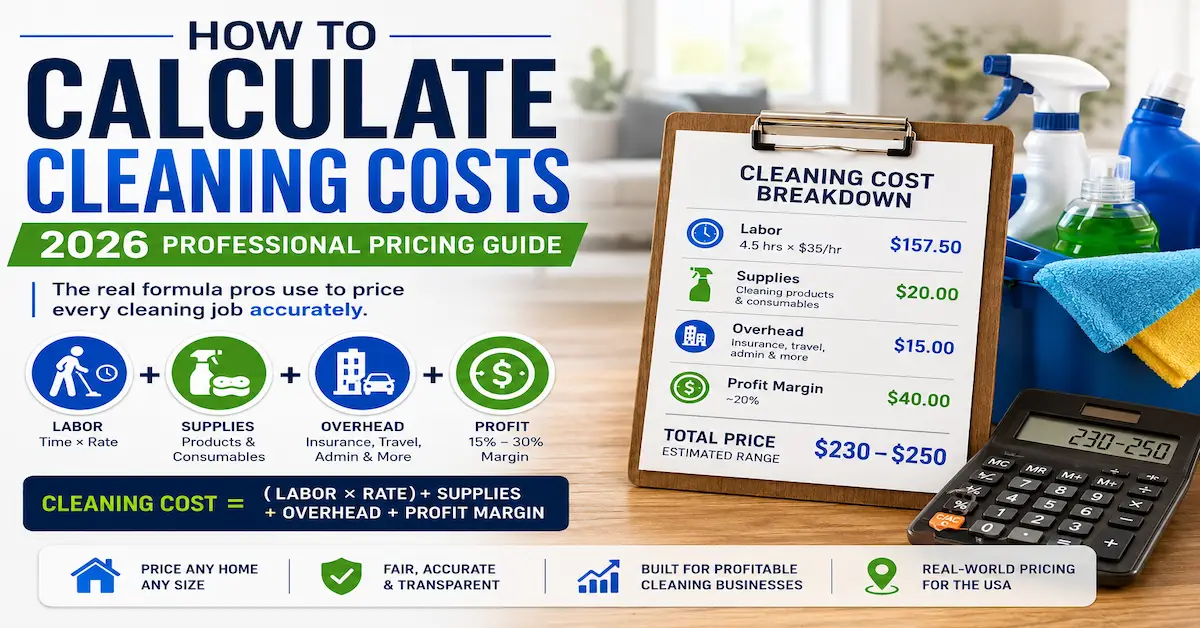
Cleaning cost = (Labor hours × hourly rate) + supplies + overhead + profit margin
This formula helps turn time and effort into a clear, fair price instead of guessing.
Here’s what each part means in real terms:
- Labor = how long the cleaning actually takes
- Supplies = cleaning products, tools, and consumables used on the job
- Overhead = transport, insurance, admin costs, and business operations
- Profit margin = the amount added so the business stays profitable
In practice, most pricing differences come from how long the job takes and how each company values its labor time.
What Actually Affects Cleaning Costs in the USA?
Cleaning prices don’t come out of thin air. If you’ve ever wondered why one quote is $120 and another is $250 for what looks like the same job, it usually comes down to a few very practical things.
Here’s what actually moves the price in real life:
Property Size and Layout
This one sounds obvious, but it’s not just about square footage.
- Bigger homes naturally take longer to clean, even if they look simple on paper
- A house with open space is usually faster to clean than one with lots of small rooms, hallways, or tight corners
- Extra bathrooms, stairs, or cluttered areas also add time fast
So two homes with the same size can still have very different pricing depending on layout.
Type of Cleaning Service
Not all cleaning jobs are equal. The type of service changes everything.
- Standard cleaning is basic upkeep dusting, vacuuming, wiping surfaces
- Deep cleaning goes into details like baseboards, grout, and behind appliances
- Move-out cleaning is the heaviest because everything needs to look “ready for the next tenant”
Naturally, the deeper the clean, the more time and effort it takes and that pushes the price up.
Labor Time (Biggest Cost Factor)
This is where most of the price actually comes from.
- Cleaners estimate how many hours a job will take
- That time is then multiplied by their hourly rate
- Faster, more experienced cleaners may charge more per hour but finish quicker
So in reality, you’re mostly paying for time and efficiency, not just “cleaning.”
Location Differences (GEO Factor)
Where you live also plays a big role in pricing.
- Cities like New York or San Francisco usually have higher cleaning rates
- Smaller towns or suburban areas tend to be more affordable
- Costs change based on local wages, rent, and business expenses
That’s why cleaning services in one state can feel noticeably cheaper or more expensive than another.
Frequency of Cleaning
How often you book a service also affects the price.
- Weekly or bi-weekly cleanings are usually cheaper per visit
- One-time cleanings cost more because everything has to be reset from scratch
- Regular clients often get discounted rates since the work is easier to maintain
In simple terms: the more often you clean, the less work builds up — and the lower each visit tends to cost.
Average Cleaning Costs in the USA (Realistic Benchmarks)
Here’s a simple breakdown of what most people actually pay across the USA. These are typical ranges you’ll see from small local cleaners to professional cleaning companies.
- Standard cleaning: $100 – $220 per visit
- Deep cleaning: $200 – $400+
- Move-out cleaning: $250 – $600+
- Hourly rate: $25 – $60 per cleaner
These numbers give you a solid baseline, but they’re not fixed rules. Some jobs fall lower, especially small apartments, while larger homes or heavily detailed work can go well above these ranges. Prices vary depending on home size, condition, and how much detail the job requires.
How Cleaning Companies Actually Calculate Your Price (Real Method)
This is the part most companies don’t really explain clearly, but it’s basically how every professional cleaner builds a quote behind the scenes.
It’s not random; it follows a simple flow that turns time into money.
Step 1: Estimate Time Needed
First thing cleaners do is figure out how long the job will take.
- Small homes: 2–5 hours
- Medium homes: 4–6 hours
- Large homes: 5–8+ hours
This depends on condition, clutter, number of rooms, and service type (standard vs deep clean).
Step 2: Multiply by Hourly Rate
Once time is estimated, it gets converted into labor cost.
Example:
- 4 hours × $35/hour = $140 labor cost
This is usually the core of the price.
Step 3: Add Supplies + Travel
Next comes the practical stuff people forget about.
- Cleaning products, cloths, gloves, etc.
- Fuel or travel time to the location
Usually adds around $10 – $30 depending on the job.
Step 4: Add Overhead Costs
This is what keeps the business running behind the scenes:
- Insurance
- Scheduling tools
- Admin work
- Business operations
It’s not always visible to customers, but it’s always part of the pricing.
Step 5: Add Profit Margin
Finally, the business adds its profit, so the work is actually sustainable.
- Typically 15% – 30% on top of the total cost
This is what turns a “job” into a real business instead of just labor-for-money.
When you put all of this together, you get the final cleaning quote, not just a random number, but a structured calculation based on time, cost, and profit.
Cleaning Cost by Pricing Model (Which One Should You Use?)
Not every cleaning job is priced the same way. Most companies don’t stick to one method; they switch depending on the job, the client, and how predictable the work is.
Here’s how the main pricing models actually work in the real world:
Hourly Pricing
This is the most flexible option.
Best for:
- One-time jobs
- First-time cleanings
- Homes where the condition is unknown
If a place hasn’t been cleaned in a while, hourly pricing protects the cleaner from undercharging. You’re basically paying for time, not guessing the outcome.
Flat Rate Pricing
This is what most homeowners prefer once things are predictable.
Best for:
- Recurring customers (weekly, bi-weekly)
- Homes with consistent condition
- Straightforward cleaning routines
You get a fixed price upfront, which makes budgeting easier. The cleaner benefits too because they already know how long the job usually takes.
Per Square Foot Pricing
This model is more common in commercial work than residential.
Best for:
- Offices and commercial buildings
- Large properties
- Open spaces with predictable layouts
Instead of estimating time manually, pricing is based on size which works well when cleaning tasks are standardized.
Most cleaning businesses combine these models instead of sticking to just one.
Real Example: How a Cleaning Job Is Priced (Step-by-Step Breakdown)
Let’s make this real. No vague talk, just an actual breakdown of how a typical cleaning job gets priced.
Example Job:
- 2,000 sq ft home
- 4 bedrooms, 2 bathrooms
- Standard cleaning (not deep clean)
Step-by-Step Cost Breakdown
Estimated time: 4.5 hours
Hourly rate: $35
- Labor: 4.5 × $35 = $157.50
- Supplies: + $20
- Overhead: + $15
- Profit margin: + ~$40
Final Price:
$230 – $250
What this shows (real insight)
- Most of the price comes from time, not just home size
- Small add-ons (supplies, overhead) still matter
- Profit isn’t random it’s built into the structure
And this is exactly why two quotes can feel different.
If one company estimates 3.5 hours and another estimates 5 hours for the same home, the final price shifts fast.
Once you understand this breakdown, cleaning quotes stop feeling confusing — they actually start making sense.
Why Cleaning Prices Vary So Much Between Companies
If you’ve ever gotten two quotes for the same home and wondered, “How are these even close?” — you’re not alone.
The difference usually comes down to how each company operates behind the scenes, not just the cleaning itself.
Experience Level of Cleaners
More experienced cleaners tend to:
- work faster
- notice details others miss
- deliver more consistent results
They often charge a bit more, but you’re paying for efficiency and fewer mistakes.
Speed of Service
Time is the biggest cost driver.
- One team might finish in 3.5 hours
- Another might take 5+ hours for the same job
Even with the same hourly rate, that difference adds up quickly.
Insured vs Non-Insured Providers
Professional companies usually carry:
- liability insurance
- worker protection
That adds to their costs but also protects you if something goes wrong. Cheaper services often skip this, which lowers their price but increases risk.
Equipment and Product Quality
Some cleaners use:
- commercial-grade equipment
- higher-quality cleaning solutions
Others stick to basic supplies. Better tools can mean better results, but they also increase operating costs.
Business Overhead Structure
Every company runs differently.
- Some have teams, admin staff, scheduling systems
- Others are solo cleaners with minimal expenses
Higher overhead usually means higher pricing but also more reliability and structure.
That’s why two quotes for the same home can look completely different.
Minimum Charges and First-Time Cleaning Pricing (Hidden Industry Logic)
This is one of those things most cleaning companies don’t explain upfront — but it plays a big role in what you end up paying.
Minimum Visit Fee
Even for small jobs, most cleaners won’t go below a certain price.
- Typical minimum: $80 – $150 per visit
- Covers travel time, setup, and basic labor
So even if your place is tiny or “just needs a quick clean,” you’ll still see a base charge. It’s not about overcharging — it’s about making the job worth the time.
First-Time Cleaning Costs More
Your first cleaning is almost always the most expensive.
- Usually 1.5x to 2x the price of a regular visit
Why?
- There’s more buildup (dust, grime, neglected areas)
- Cleaners don’t know the space yet, so time estimates are less predictable
- Extra detail work is needed to “reset” the home
After that first visit, things get easier to maintain, which is why recurring cleanings are cheaper.
The Real Reason Behind This Pricing
It comes down to two things:
- Buildup: The longer a space goes without cleaning, the more effort it takes
- Time uncertainty: First-time jobs are harder to estimate accurately
So companies price the first visit higher to avoid underestimating the work.
Once you understand this, those higher first-time quotes make a lot more sense they’re not random, they’re just accounting for extra effort upfront.
Cleaning Cost Estimation Tips (For Homeowners & Businesses)
Once you understand how pricing works, estimating cleaning costs gets a lot easier. But there are still a few practical things that can save you money or protect your profits depending on which side you’re on.
For Homeowners
If you’re hiring a cleaning service, don’t just look at the final number.
- Ask for a breakdown, not just a total price
A good company should be able to explain what you’re paying for time, service type, and any extras. - Compare hourly vs flat rate
A flat rate might look higher upfront, but it can be cheaper if the job runs long. Hourly works better for smaller or unpredictable jobs. - Be clear about what you need
Saying “just a normal clean” vs listing specific tasks can change the quote more than you think.
For Cleaning Businesses
If you’re pricing jobs, small mistakes add up fast.
- Track time per job
This is the biggest one. If you don’t know how long jobs actually take, your pricing will always be off. - Don’t underprice labor
Trying to win jobs by being the cheapest usually backfires. You end up working more for less. - Include overhead properly
Fuel, supplies, tools, software it all counts. Ignoring these eats into your profit without you noticing.
Whether you’re booking a service or running one, the goal is the same: understand what goes into the number so you’re not guessing.
Get a Clear Cleaning Quote
If you’d rather skip the estimating and just get a straight answer, that’s completely fair. At the end of the day, every home and office is different, and the most accurate pricing always comes from a quick, real assessment.
If you want a clear, upfront cleaning quote based on your space, Prestij Cleaning can help you figure out the right price without confusion or surprises.